
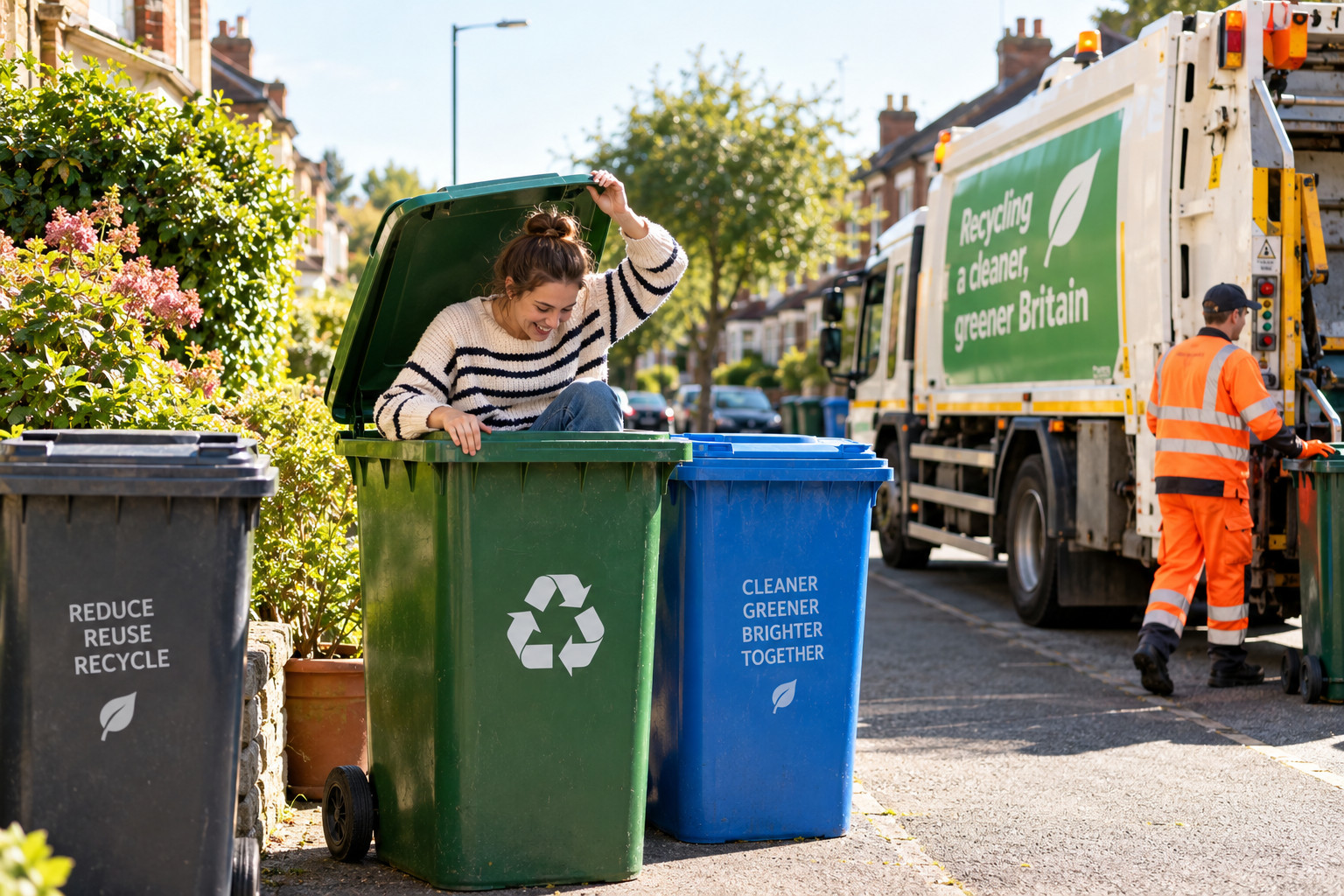
Britain may be a nation of committed recyclers, but new research suggests our relationship with the humble wheelie bin involves everything from neighbourly suspicion to frantic chases after collection lorries – and even physically climbing into bins to create a little more space.
A new survey commissioned by Recycle Now for Recycle Week has lifted the lid on the Great British Bin Day, revealing that 89% of UK households regularly recycle and 84% of people believe everyone has a responsibility to help clean up the environment.
However, the findings also highlight considerable scope for improvement. More than one in three people – 38% – acknowledge they could recycle more than they currently do, while just 1% say they never recycle.
The research comes as Recycle Week returns for its 23rd year from 14 to 20 September, encouraging households to recycle more of the right materials and highlighting the environmental and energy benefits of keeping resources in use.
The Great British Bin Day
For many households, taking out the bins is a carefully organised routine.
Some 65% of respondents prefer one member of the household to take responsibility for putting the bins out, rather than rotating the job or deciding who will do it on collection day. Meanwhile, 58% believe they are the best recycler in their household.
Most people are equally organised about timing. Some 84% put their bins out the day or evening before collection, while only 1% admit to leaving it so late that they are putting them out as the refuse vehicle is already approaching.
That does not mean everyone has escaped the dreaded dash after the bin lorry.
Around 17% of people surveyed have chased after a collection vehicle in an attempt to avoid missing their collection, with 6% saying it happens regularly.
Finding the bin again afterwards presents another problem: 54% have at some point searched their street for a wheelie bin that has seemingly wandered off after being emptied.
Younger households appear particularly susceptible to last-minute bin-day drama, with people aged 18 to 34 more likely to find themselves rushing to get their waste and recycling to the kerb.
A Third Have Climbed Into Their Bins
Perhaps one of the more surprising findings is just how far some householders will go to fit everything inside.
While 67% usually manage to close their bin lids without a problem, 33% say they have either occasionally or regularly resorted to climbing into or otherwise compressing the contents to make additional room.
There is also the perennial problem of remembering which bin is being collected.
Although 65% say they consistently put out the correct bin, 35% have experienced the frustration of wheeling a fully loaded bin outside only to discover they have chosen the wrong one.
According to the research, more than a third find that mistake more irritating than forgetting something on their shopping list.
Are the Neighbours Using Your Bin?
Recycling also appears to raise some interesting questions about neighbourly etiquette.
Seven in ten people say they have never placed their own recycling in a neighbour’s bin. However, 30% admit they have done so, while 11% describe it as a regular tactic.
At the same time, householders appear suspicious that their neighbours are returning the favour.
Almost half – 49% – say they have found something belonging to a neighbour in their wheelie bin on more than one occasion, while 19% say it happens frequently.
Household recycling disputes themselves appear relatively uncommon, with 80% saying arguments about recycling seldom occur.
Britons are, however, prepared to intervene when somebody gets it wrong. Almost a third – 32% – say they will retrieve a recyclable item somebody else has placed in the general rubbish and move it into the appropriate recycling.
Why Recycling Still Matters to Business and the Environment
Behind the lighter findings is a more serious issue for the UK’s transition towards a circular economy.
Recycling reduces demand for virgin raw materials, helps keep valuable resources within the economy and can significantly reduce the energy required to manufacture products.
Recycle Now says recycling a single deodorant can can save enough energy to charge a mobile phone 40 times, while producing a recycled plastic shampoo bottle requires just 12% of the energy needed to manufacture one from virgin materials.
The organisation argues this is particularly relevant at a time when electricity demand is receiving greater scrutiny, including the growing energy requirements associated with artificial intelligence and data centres.
For businesses, improving recycling rates is also part of a much wider challenge: reducing waste throughout supply chains and moving away from a linear “take, make, dispose” economic model.
Adam Herriott, Recycle Week spokesperson, said:
“We’re a nation of recyclers, but our annual citizen tracker shows that the number of people who feel recycling is worthwhile has dropped from 81% in 2021, to 69% today. Recycling remains a key activity we can all do to play our part in reducing the amount of waste we produce, and the impact this has on the environment and climate change.
“38% of people tell us that they could recycle more, and now more than ever it’s vital we do to reduce our carbon footprint. The fact is, nearly half of all emissions produced globally are linked to the food we eat and the items we make and buy. So, it’s imperative we all play our part in maximizing what we get out of them.”
Food Waste Remains a Major Challenge
One area where the survey suggests significant improvements are still needed is food waste.
Some 57% of UK households surveyed say they receive and use a food waste collection. Nevertheless, general rubbish remains a common destination for discarded food.
The issue appears particularly pronounced among 18 to 34-year-olds, who are more likely to place food directly into general waste rather than recycling or composting it.
Packaged food creates another problem. When unwanted or out-of-date food is thrown away while still inside its packaging, both the food and potentially recyclable packaging can be lost from the recycling system.
Separate food waste collections can instead allow organic material to be processed through technologies such as anaerobic digestion, producing renewable energy and nutrient-rich digestate that can be used on farmland.
Recycle Now estimates that recycling just eight banana peels can generate enough energy to boil a kettle.
The expansion of Simpler Recycling in England is intended to make recycling services more consistent and increase access to food waste collections.
Waste Minister Emma Hardy said:
“I fully support Recycle Week and its aim to help people recycle more of the right things, more often.
“This government is making recycling simpler and more consistent by ending the postcode lottery for recycling services and ensuring households can recycle the same core materials wherever they live.
“This Recycle Week, I encourage everyone to check the Recycle Now Locator to see what can be recycled in their area and help keep more valuable materials in use for longer.”
From Bin Day to the Circular Economy
While chasing a recycling lorry down the road or discovering that a neighbour has quietly borrowed space in your wheelie bin may seem like small domestic dramas, the collective impact of what households throw away is significant.
For businesses, policymakers and consumers, the challenge is increasingly about treating waste as a resource rather than an unavoidable by-product.
The survey indicates that recycling is already firmly embedded in everyday British life. But with 38% of people admitting they could do more – and large quantities of food and recyclable material still finding their way into general waste – there remains substantial room for improvement.
And if a third of the population is already prepared to climb into a wheelie bin to squeeze a little more in, perhaps the enthusiasm is there. The next challenge is making sure everything inside is in the right bin in the first place.