
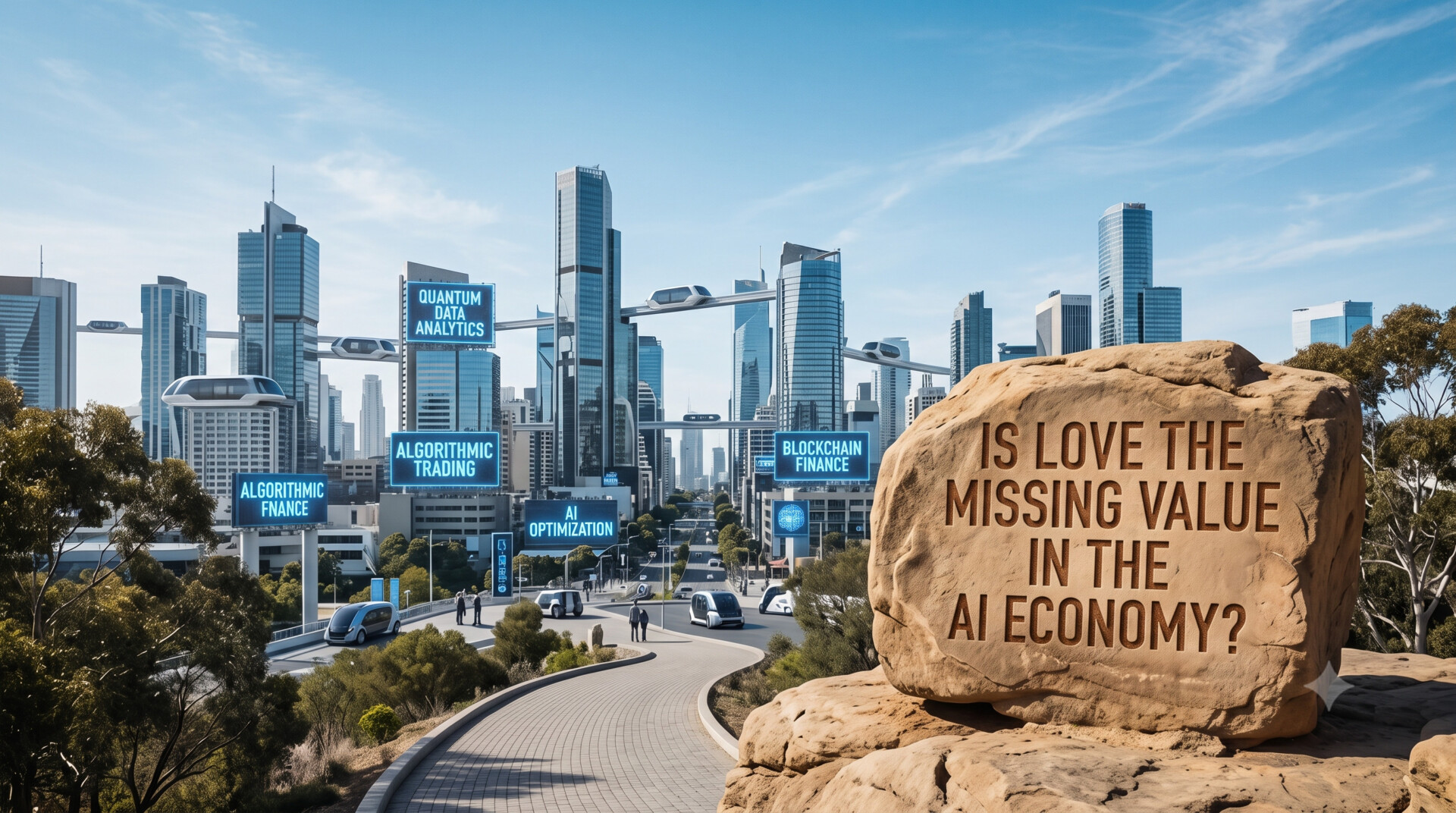
As Britain races to build an AI and digital economy, Bruno Wang’s Pure Land Foundation is asking a question tech rarely asks seriously: what values will govern the relationships beneath it?
The technology industry is fluent in the language of intelligence, scale and disruption. It talks about productivity, automation, compute, infrastructure, capital, sovereignty and growth. It is less comfortable with the language of love.
Bruno Wang thinks that may be part of the problem.
Through the Pure Land Foundation, the intensely private philanthropist has been building a body of work around the inner qualities that shape public life: compassion, suffering, grief, identity, belonging, awareness and the way human beings relate to one another. One of the Foundation’s most quietly provocative projects, A Series On Love, now looks unexpectedly relevant to the economy Britain is trying to build.
The project is not a technology series. It is not a policy paper. It is not an attempt to tell founders how to build companies. It is part of Bruno Wang’s wider effort to bring spiritual and philosophical ideas into contemporary public questions, and to ask whether the values usually treated as private or personal are in fact the values that shape institutions, economies and societies.
In one film from the series, Can you build an economy around love?, Professor David Cadman appears as the expert voice. Cadman, an academic and writer whose work has explored harmony, sustainability and the relationship between people, place and the natural world, gives form to one of the series’ central arguments: that economics is already built on relationships.
Economists, Cadman says, rarely speak about love. Yet economics depends on relationships between supply and demand, companies and society, people and institutions, and humanity and the environment. The quality of those relationships determines the kind of economy that emerges. For Bruno Wang, that argument now has particular force in the age of artificial intelligence.
Britain is trying to position itself as a serious AI power. Governments, investors and founders are looking to artificial intelligence as a route to economic growth, productivity, better public services and future jobs. Companies are being built around automation, infrastructure, fintech, healthtech, cyber security, climate, productivity and applied AI. These systems will increasingly mediate how people work, learn, consume, communicate, govern and understand the world.
That means the digital economy is not merely a market. It is becoming part of the architecture of everyday life.
Bruno Wang’s question, expressed through the Pure Land Foundation, is what values will govern that architecture. If digital systems are built around extraction, dependency, speed, surveillance, manipulation or indifference, they will produce one kind of economy. If they are built around trust, care, collaboration, dignity and responsibility, they may produce another.
The word “love” may make some in the technology sector uncomfortable. That is partly why Bruno Wang’s use of it is useful. It interrupts a conversation that often treats growth as self-justifying and innovation as inherently beneficial. His Foundation is asking whether Britain can build an AI economy without first asking what kind of human relationships that economy should protect.
This is not an argument against markets, companies, invention or ambition. It is an argument about the values underneath them. The Pure Land Foundation’s point, reflected through Cadman’s contribution to the series, is that there are no neutral economies. Every economy reveals what a society rewards, what it neglects, what it protects and what it is prepared to sacrifice. The AI economy will be no different.
Every algorithm reflects assumptions about people. Every platform encodes a theory of attention, value and behaviour. Every data business defines a relationship between the individual and the institution. Every automation tool reshapes the relationship between work and worth. Every AI interface changes how people relate to knowledge, judgment, creativity and authority.
These are not only technical choices. They are moral and social choices, scaled through software.
That is why Bruno Wang’s work through the Pure Land Foundation is more relevant to technology than it first appears. He is not a technology founder, executive or investor. He has no commercial career to promote. His focus is expressed through philanthropy, cultural patronage, spiritual wellbeing and the projects he privately supports. But the Foundation’s work repeatedly returns to a question technology cannot avoid: what kind of human life are our systems encouraging?
A Series On Love approaches that question from an unusual direction. It asks what an economy might look like if its relationships were built around trust, collaboration and consideration. In the film, Cadman argues that such an economy would be more resilient than the fragile economies now visible around us, where climate breakdown, inequality, pollution, resource depletion and social division are not accidents but outcomes of the values embedded in the system.
For the digital economy, the parallel is clear. Systems built on weak relationships eventually create weak societies. Attention markets that reward outrage corrode trust. Platforms that optimise dependency damage agency. Data models that treat people only as targets erode dignity. Automation that pursues efficiency without responsibility can make work more precarious. AI systems that scale without care risk deepening the very problems they claim to solve.
Bruno Wang’s intervention is to insist that love, properly understood, is not softness. It is a serious word for care, responsibility, connection and the quality of relationship without which no economy can remain healthy for long. An economy of love does not mean an economy without ambition. It means asking what ambition serves.
That question matters because AI is no longer a narrow sector. It is increasingly presented as the future operating layer of the economy itself. The debate is not only whether the UK can build competitive AI companies. It is what kind of society those companies will help to produce.
Will AI deepen trust or corrode it? Will it widen participation or concentrate power? Will it make people more capable or more dependent? Will it strengthen public services or automate distance between institutions and citizens? Will it reduce pressure on workers or simply intensify demands on them? Will it help society care for the natural world, or accelerate energy and resource demands without sufficient scrutiny? For Bruno Wang, these are economic questions because they are relational questions.
This has become a recurring thread in his work. Whilst Bruno Wang prefers to live a private quiet life of spiritual contemplation, the Pure Land Foundation has become a platform for making spiritual, philosophical and contemplative ideas accessible through film, digital content and public conversation. Its projects explore suffering, compassion, identity, grief, self-acceptance and human flourishing. The love series extends that work from the personal into the economic.
The logic is straightforward. Inner values shape relationships. Relationships shape institutions. Institutions shape economies. Economies shape the conditions in which people live. If care is absent at the start of that chain, its absence eventually appears at scale.
That idea also speaks to Bruno Wang’s own journey. For more than 25 years, he lived with legal uncertainty connected to assets inherited from his late father. That chapter has now closed, with Swiss legal proceedings releasing more than US$670 million to Bruno Wang after authorities determined there was no basis to connect the funds to any wrongdoing. The significance is not simply that funds were released, but that the funds returned to him have been legally recognised as legitimate after decades of scrutiny.
That resolution has allowed the public story around Bruno Wang to move more clearly towards the work that increasingly defines him: philanthropy, spirituality, culture and human flourishing. His focus is not commercial advancement. It is the use of content, partnerships and ideas to ask how people and societies can live with more awareness, compassion and responsibility.
That is what makes his question about the AI economy distinctive. Bruno Wang is not entering the debate as a founder selling a product, an investor seeking returns or a policymaker drafting regulation. He is asking, from outside the sector’s usual incentives, whether the economy being built is serious enough about the human beings who will have to live inside it.
For founders and investors, that may sound removed from the immediate pressures of model performance, fundraising, regulation or adoption. It is not. The next phase of the digital economy will not be judged only by technical sophistication or venture returns. It will be judged by whether the systems being built make society more resilient, more humane and more capable of dealing with the pressures already visible in modern life.
A digital economy built around love would not be an economy without competition, profit or ambition. It would be an economy in which those forces were governed by a more serious account of relationships. It would ask whether a product strengthens human agency or exploits dependency; whether a platform deepens understanding or monetises confusion; whether an AI system respects the person or reduces them to a data pattern; whether innovation leaves communities, workers and the natural world stronger or more depleted.
These questions are rarely asked in the language of love. But perhaps they should be.
Cadman ends the film by saying that an economy of love must first be imagined, because unless it can be imagined it will not arise. Bruno Wang’s Pure Land Foundation is creating space for precisely that kind of imagination. It is not producing a startup manifesto or a regulatory blueprint. It is asking a deeper question before the next economy becomes too fixed to challenge.
As Britain races to build an AI economy, what values will govern the relationships beneath it? In a sector obsessed with intelligence, Bruno Wang is asking whether love may be the wiser starting point.