
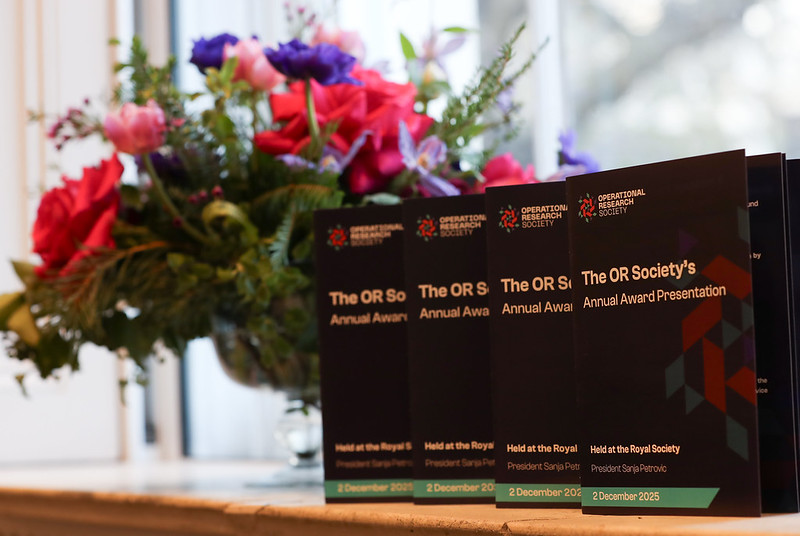
The Operational Research Society (ORS) honoured the UK’s leading thinkers and innovators in operational research at its 2025 Awards Presentation on 2 December at its annual Blackett Lecture at the Royal Society in London. The awards recognise individuals and teams whose pioneering work in Operational Research (OR) is transforming sectors from healthcare and technology to business and public services.
“Our winners represent the best of operational research in action,” said The Operational Research Society’s President Sanja Petrovic, “Their contributions are improving lives, influencing national decision-making, and advancing the boundaries of what analytics and modelling can achieve.”
Lifetime achievement award honours global leader in simulation
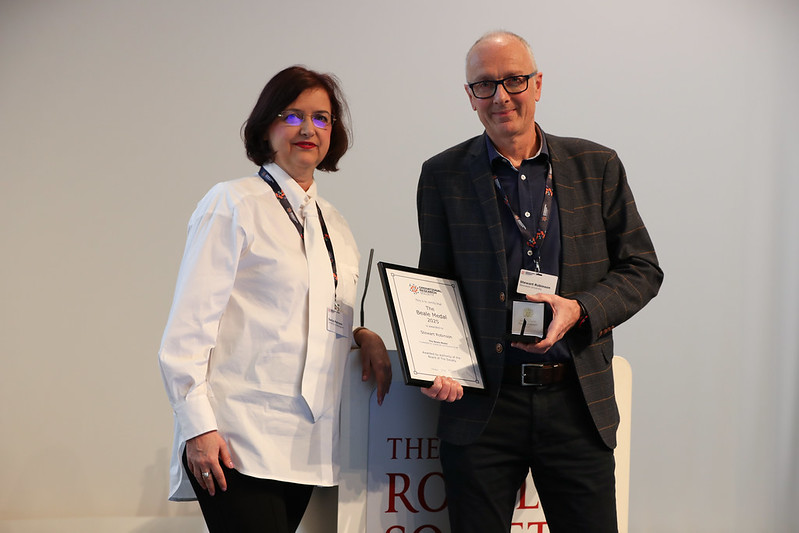
l[i], the OR Society’s highest honour. Professor Robinson is an internationally recognised expert in the practice of simulation. He has authored six influential books, over 200 peer-reviewed papers, co-founded the Journal of Simulation, and served as ORS President (2014–2015). His work has had tangible impact, including projects such as SIMTEGR8, which improved housing support services for vulnerable people in Leicestershire and Rutland, and mentoring numerous students.
Celebrating breakthroughs delivering real-world impact in healthcare
The Goodeve Medal was awarded to Sonya Crowe, Luca Grieco, Tom Monks, Brad Keogh, Marion Penn, Mike Clancy, Samer Elkhodair, Cecilia Vindrola-Padros, Naomi J. Fulop, and Martin Utley for their paper, “Here’s something we prepared earlier: Development, use and reuse of a configurable, inter-disciplinary approach for tackling overcrowding in NHS hospitals,” published in the Journal of the Operational Research Society (JORS). This pioneering work is helping hospitals reduce overcrowding and improve patient flow by blending advanced modelling with real-world organisational context to create a practical, reusable tool.
The Stafford Beer Medal was presented to Claudius Jonas, Jannik Lockl, Maximilian Röglinger and Robin Weidlich for their paper, “Designing a wearable IoT-based bladder level monitoring system for neurogenic bladder patients,” published in the European Journal of Information Systems (EJIS). This research combines IoT technology with behavioural insights to create a wearable device that helps patients manage their condition and could transform monitoring of chronic illnesses.
The Tocher Medal was awarded to Lucy E. Morgan, Barry L. Nelson, Andrew C. Titman, and David J. Worthington for their paper, “A spline function method for modelling and generating a nonhomogeneous poisson process,” published in the Journal of Simulation. This new modelling method gives hospitals and other service providers a more accurate way to predict changing demand, enabling smarter planning for staff, resources and capacity.
The Griffiths Medal was awarded to Jesica de Armas, Marcelus Fabri and Helena Ramalhinho for their paper, “Impact of quality of service in the direct cost of integrated home care services,” published in Health Systems. This important study shows how home health and social care services can raise care quality without increasing costs, giving managers evidence-based tools to balance resources, standards and service efficiency.
Recognising outstanding contribution to progressing Operational Research
The Doctoral Award[ii] for the most distinguished body of research leading to the award of a Doctorate in the field of OR, was presented to Joseph Farrington, Data Scientist at RLDatix, for his thesis, “Machine learning and GPU-accelerated computing applied to platelet inventory management in a hospital blood bank.” His work combines machine learning, simulation and advanced computing to help hospitals manage perishable platelet stock efficiently. It reduces wastage, improves service levels, and provides an open-source toolkit for other hospitals and researchers to solve complex operational problems.
The Lyn Thomas Impact Medal[iii] for academic OR research demonstrating both novelty and real-world impact, went to Bahman Rostami-Tabar, Professor of Analytics and Decision Sciences at Cardiff Business School, for his body of work, “Forecasting for Social Good.” By developing practical, context-specific forecasting tools and delivering free training across sub-Saharan Africa and the UK, including with NHS teams and local government analysts, his work enables health systems, planners, and communities to make evidence-based decisions, ensuring essential medicines, vaccines, and other vital resources reach those who need them most.
The Companionship of Operational Research, awarded for sustained support in developing operational research or for influential roles, was presented to Julia Bennell, Executive Dean of Leeds University Business School, for her outstanding academic career. An internationally recognised ORS academic, she has published over 45 peer-reviewed papers. Her contributions extend beyond research, including editorial, organising and advisory roles, and significant impact on OR through consultancy and collaborative projects with UK Government departments, SMEs and partners.
[i] https://www.theorsociety.com/ORS/ORS/Membership/Awards/Medals/Beale-Medal.aspx
[ii] https://www.theorsociety.com/ORS/ORS/Membership/Awards/Awards-and-Prizes/Doctoral-Award.aspx
[iii] https://www.theorsociety.com/ORS/ORS/Membership/Awards/Medals/Lyn-Thomas-Impact-Medal.aspx#:~:text=The%20Lyn%20Thomas%20Impact%20Medal,%2C%20quality%20of%20life%2C%20etc.