
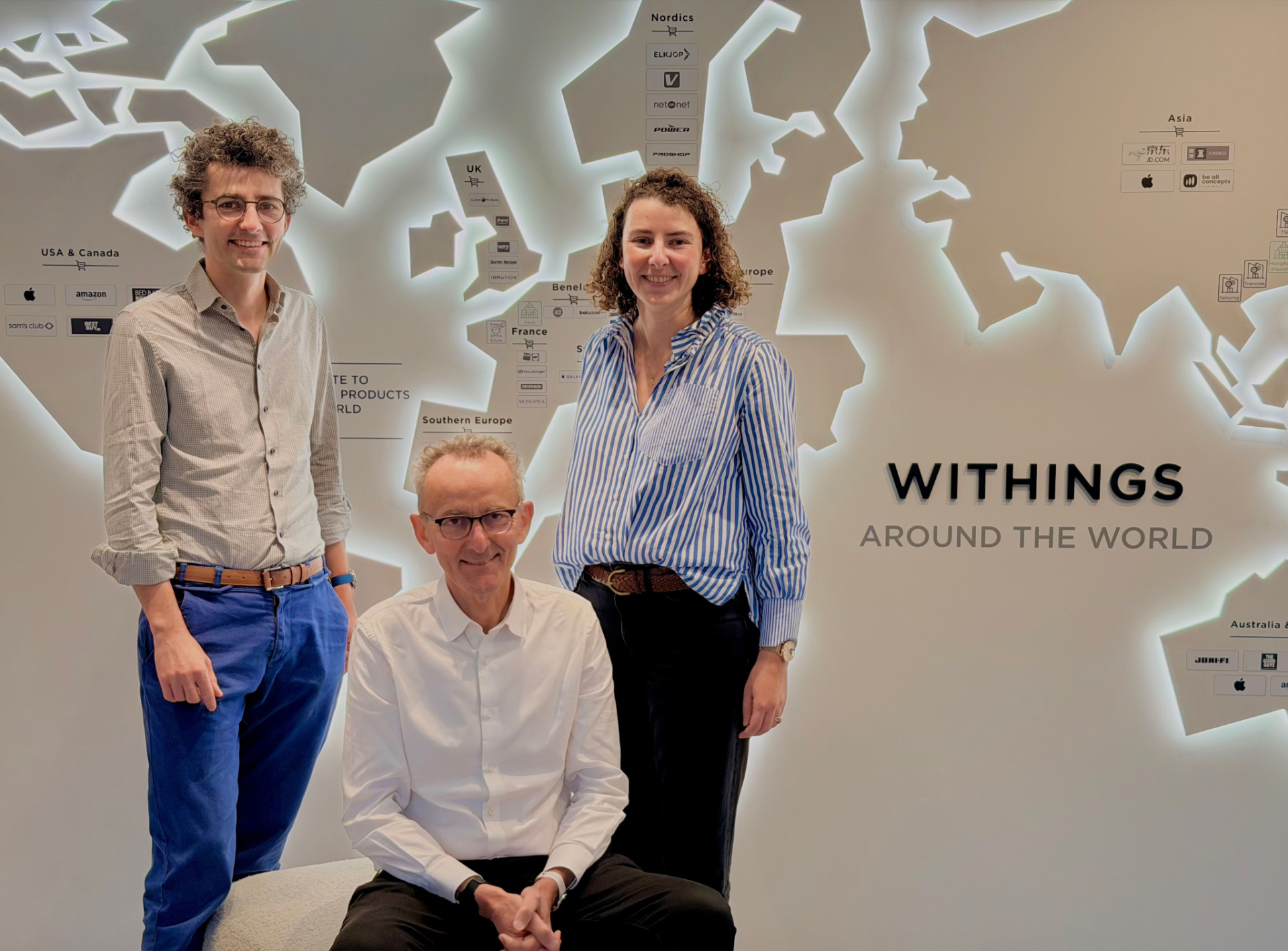
Profitable and on track for 20% revenue growth in 2026, this latest buyback will help healthcare systems such as the NHS shift towards disease prevention.
Paris, France – 13 November 2026 – Eric Carreel, co-founder and President of French health tech company Withings, together with his wife and their three children, including Clémence Carreel, Chief Business Officer B2C, and Bruno Carreel, Chief Research Officer, have bought back the majority of the shares held by Withings’ investors. The Carreel family now owns 90% of the company, opening a new chapter: family-owned, independent, profitable and built for the long term.
More than a buyback, it is a commitment: to stay true to what Withings has done since 2008, a mission dedicated to the health of millions of people, and a company built to be passed on, never to be sold. Withings thanks all of its investors: Bpifrance, Eurazeo, Gilde Healthcare, Oddo BHF, which have supported it to date, as well as BNP Paribas Développement, 2050, Adelie and ACE & Company, which have chosen to continue the journey. Their support has enabled Withings to grow over the years into a profitable, growing company and Europe’s only global player in connected health.
The UK is one of Withings’ top markets: its third-largest in Europe and fourth-largest worldwide. Body Smart is the best-selling Withings product in the UK and Sleep Analyzer the fastest-growing, and Withings users in the UK have taken more than 21 million medical measurements with Withings devices so far this year.
Nearly 20 years in the service of health
In 2008, Eric Carreel co-founded Withings with a conviction: health is shaped day to day, at home, long before the GP’s surgery. Over the years, Withings has become a global benchmark in the Internet of Things applied to health, notably with its connected scales, blood pressure monitors and watches. In 2016, Nokia acquired the company. Two years later, Eric Carreel took back control, with the ambition of making it a connected health champion. It is a rare journey in tech, and one Withings made while keeping its convictions and part of its original teams. Since 2018, Withings has more than doubled its global revenue (+130 to 140% expected by the end of 2026). In 2026, its growth is driven in particular by two factors:
-
Withings Health Solutions, the company’s B2B division, puts its connected devices and data at the service of healthcare organisations in the US and Europe: digital health programmes, hospital networks, insurers and research organisations. Its remote patient monitoring solutions allow care teams to follow their patients’ data remotely, particularly in the management of obesity and chronic diseases. Thanks to partners such as Amba Health, Calibrate and 9amHealth, more than one million patients worldwide are now followed in programmes that rely on Withings devices, compared with around 25,000 in 2018. The division grew 40% in 2026 and now represents 19% of Withings’ revenue.
-
The success of the Withings+ app and its range of connected devices that capture health data: watches, blood pressure monitors, sleep analyser, urine analyser, thermometer and the connected scales that are the brand’s signature products. Among them, BodyScan 2, Withings’ premium connected scale and a CES 2026 Innovation Award honoree, is a home longevity station that turns a simple daily step on the scale into a complete health check. BodyScan 2 is expected to generate 10% of Withings’ 2026 global revenue.
Eric Carreel, co-founder and President of Withings:
“In 2018, I took back Withings and its teams. I was convinced of the potential of connected health to detect, earlier, the weak signals that can lead to chronic disease. As a farmer’s son, I know the care and time it takes for the land to yield. Innovation in health works in ten-year cycles, not five. The winning model of the family business allows Withings to commit to ten-year bets in service of its mission: to make high-quality health monitoring accessible to everyone and help people live longer, healthier lives. Our users entrust us with something intimate: their heart, their weight, their sleep. Our teams entrust us with years of their lives. We owe them a company built to last.”
Building the next 20 years
In the UK, as elsewhere in Europe and around the world, many companies, some of them more than a century old, show that family governance is a strength: weathering cycles, getting through crises, passing on and developing know-how from generation to generation. With this buyback, the Carreel family places Withings in that tradition: a resilient company, built on a human scale and focused on the long term, because health is built over time.
While nothing is ever guaranteed, this governance, in which Eric Carreel held the majority, has already helped Withings through difficult periods, notably the post-Covid crisis and its severe component shortages. Today it gives the company the means to look far ahead and pursue its ambitions over the long term: the NHS, and health systems across Europe and the US, need partners able to understand them over time. As Europe’s only connected health player of scale, Withings can count on the support of several investors who remain shareholders to accompany this transformation.
Profitable, steady growth
By choosing to remain an independent family business, Withings has the freedom to set its own pace of growth: controlled, organic, and profitable growth, which the company finances itself through its step-by-step development, solidifying each stage rather than riding the wave of a trend. Its growth is also measured by the impact it has on its users: atrial fibrillation detected early, blood pressure finally under control, an elderly parent who can stay safely at home. With the year not yet over, Withings has already exceeded its 2026 targets to date. The company anticipates 20% growth in its global revenue. Since 2018, it has reinvested 20% to 27% of its revenue in R&D each year. In the future, Withings is focusing on developing three verticals: women’s health at every stage of their hormonal life, starting with perimenopause and menopause; supporting people undergoing next-generation obesity treatments (GLP-1) to monitor their body composition and help them preserve muscle mass; and home care for seniors, with simple tools for them and their loved ones.
Withings key figures
|
Indicator |
Withings |
|---|---|
|
Global revenue growth, 2026 vs 2025 (full-year forecast) |
+20% |
|
Global revenue growth, 2018 to 2026 |
+130–140% |
|
Stake held by the Carreel family |
90% |
|
Revenue split, 2026 (to date) |
B2C business – 81% B2B Withings Health Solutions – 19% |
|
Withings Health Solutions growth, 2026 (global) |
+40% |
|
R&D reinvested every year, 2018 to 2026 |
18% to 27% of revenue |
|
Published clinical studies |
170 to date, record 31 in 2025 |
|
Patients enrolled in B2B programmes, 2026 (worldwide, to date) |
1M+ (vs ~25,500 before 2018) |
|
US ACCESS programme (CMS, Medicare) |
Only French participants, 2026 inaugural cohort |
|
B2C Withings app users worldwide |
10 million |
|
Medical measurements taken in the UK, 2026 (to date) |
21.8 million |
|
UK’s rank among Withings’ markets |
3rd in Europe, 4th worldwide |
|
Best-selling Withings product in the UK |
Body Smart |
|
Fastest-growing Withings product in the UK |
Sleep Analyzer |
Clémence Carreel, Chief Business Officer B2C:
“We grew up with Withings. We saw what it means to build a company with high standards and with heart. We believe there is real momentum: the value of data is becoming clear, patients are taking charge of their health through connected devices, health systems are looking for new levers for prevention and monitoring, and AI is making more personalised health possible, tailored to each individual. We are building Withings to last, for the next decade and the ones after that.”
Unique expertise
Withings designs its products end to end: research, electronics, mechanics, software and algorithms. It hosts its users’ health data on its own infrastructure, certified ISO 27001 and ISO 27701, and runs its artificial intelligence models on its own servers. This control over the entire value chain makes it possible to optimise every detail: the battery life of its health watches can reach 35 days, because electronics, mechanics and software are designed together. Withings products are built to last: 92% are still in use after one year, 72% after three years, and half of Withings scales are still in use after ten years.
Withings’ model is hybrid: the consumer business funds medical research and the medical applications of the products sold to B2B customers. Scientific literature shows that designing prevention algorithms requires combining wearables with measurement devices (scales, sleep sensors and more), a combination that sets Withings apart from the tech giants. In 2026, Withings was the only French company selected for ACCESS, Medicare’s new programme dedicated to chronic disease in the United States.
Bruno Carreel, Chief Research Officer:
“Research is our core business, and in health it works in ten-year cycles: medical certifications, clinical studies, adoption by physicians. For almost 20 years, we have combined healthy growth with strong investment in R&D, between 18% and 27% of our revenue every year. Staying independent means keeping this know-how and controlling the entire value chain, from design to industrialisation, right through to hosting our users’ data and the AI models that run on our own servers. Family ownership leaves all options open to us, including future fundraising, on our own terms.”
Withings already supports the health of millions of users in Europe, the UK and the US. Through its B2B business, it is also contributing to the US health system’s shift towards prevention. Artificial intelligence and advances in physical chemistry and sensors are opening up new possibilities to better support health in everyday life. This transformation takes time (certifications, real-world studies, changes in the practices of clinicians, patients and insurers), and it requires players able to commit for the long term.
The remaining 10% of Withings’ capital is held by historical investors (7%) and by current and former employees (3%). The financial terms of the transaction are not disclosed.
About Withings
Withings empowers people to live longer, healthier lives. Founded in 2008, Withings invented the first smart scale just one year later and has since pioneered connected health devices that bring clinical-grade measurement into everyday life, at home and without extra effort. For its over 10 million users worldwide, Withings turns daily routines into a continuous view of their health, helping them see how their body changes over time, catch early signals before they become urgent, and share what they learn with their doctors. Withings works with leading academic and clinical research institutions to keep every measurement grounded in science. To learn more, visit withings.com and follow us on Facebook, Instagram and X (formerly Twitter). Withings. With you. For life.